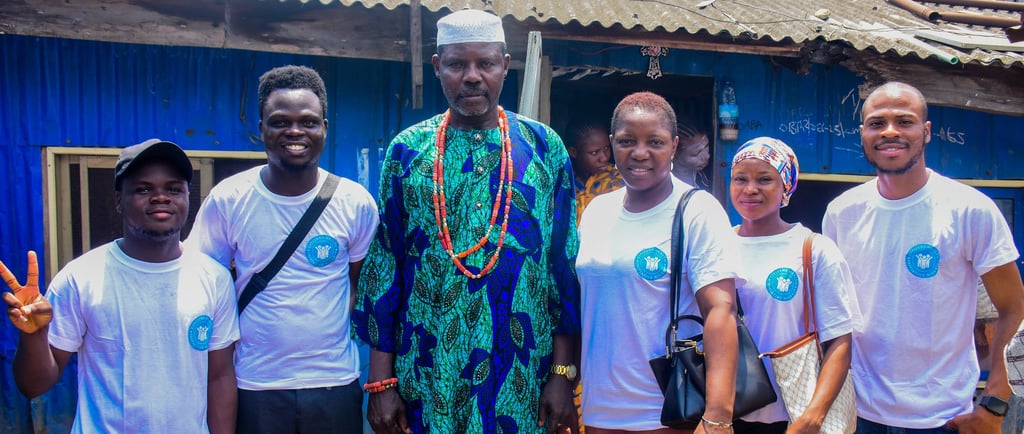

Makoko, Lagos – If you have ever seen a photograph of Makoko, you’ve likely seen the chaos first. The floating shantytown, often called the "Venice of the Slums," is usually depicted as a place of extreme poverty, open sewers, and climate vulnerability.
But if you ask Chin, you’re looking at the wrong things.
For the past several weeks, Chin—a community development facilitator with a quiet intensity and a deep respect for local knowledge—has been conducting something rare in Makoko. He isn’t running a survey driven by a foreign NGO’s checklist. He isn’t handing out tablets with pre-set questions written in academic English.
Instead, Chin has been carrying out a Community-Led Asset Assessment, and the results are challenging everything outsiders thought they knew about this historic fishing community.
The Chin Method: Wading, Listening, Mapping
Chin didn’t set up an office. He used a canoe.
Over ten days, he visited three distinct zones of Makoko: the stilted land zone, the floating wood zone, and the “Brazil” side (the more established upland area). He didn't bring a clipboard. He brought a notebook and a local translator.
He looked for three specific assets:
Individual Assets (Skills): Who knows how to fix a boat engine? Who is the best fish smoker? Who can read English well enough to translate for the clinic?
Social Assets (Relationships): Which women run the savings groups (ajo)? Which pastor has the largest congregation for mobilizing volunteers? Who resolves land disputes?
Physical Assets (Infrastructure): Where are the private boreholes that could be used in a fire emergency? Which floating platforms are stable enough to serve as temporary classrooms?
What Chin Found
The initial findings are stunning for those who only see Makoko through a lens of crisis.
The Carpenters’ Guild: Chin identified over 200 skilled carpenters living on the water. They build everything—from the stilts to the schools. They don’t need job training; they need access to treated timber.
The “Floating Economy”: There is an informal recycling chain that processes over 60% of the community’s plastic waste. It is run entirely by teenage boys using homemade nets. The asset isn’t the plastic; it’s the logistics network these boys built.
The Water Taxi Union: While the government sees chaotic transport, Chin mapped a highly organized system of 400+ canoe paddlers who know the tide schedules, the shallow spots, and every family on their route. They are a built-in early warning system for floods.
The Shift in Power
The most important result isn't on the map. It is the conversation.
"When Chin asked me what I could do, not what I needed, I sat up straighter," said Fatima, a fish processor who participated in the assessment. "For twenty years, journalists come and take pictures of my smoke. They write 'poor woman.' Chin asked me how much fish I dry per week. He asked me to teach him. That is respect."
Chin’s assessment is now being handed back to the Makoko Community Development Committee—not to a donor in Europe.
The plan is to use the asset map to negotiate. Instead of begging for "charity," the community can now propose partnerships. For example:
"You have funding for flood barriers? We have 400 canoe paddlers who can install them in two days."
"You want to run a health clinic? We have three trained community health workers already living here."
The Lesson for Development
Chin’s work in Makoko is a quiet revolution. In a world obsessed with fixing the "bottom billion," he simply sat in a canoe and asked, "What is strong here?"
The answer, it turns out, is a lot more than the stilts holding up the houses.
If we want to build resilient communities, we need to stop seeing them as problems to be solved and start seeing them as partners to be mobilized. Chin proved that in Makoko, the greatest asset isn't a building or a road—it's the ingenuity of the people who refuse to sink.